MSA Insurance Tripwires Every First-Time Hardware Founder Misses Before Signing
Signing before checking policy wording can breach your contract.

MSA insurance clause review for hardware and robotics startups must compare the contract’s requirements with actual policy wording as well as a certificate of insurance. Coverage types, limits, additional insured endorsements, indemnification structures, and reporting periods must fit the losses autonomous hardware can cause. Signing before that comparison can leave a company both uninsured for a loss and in breach of its customer contract.
Why enterprise and government MSAs have become an insurance problem for hardware founders
A founder receives an enterprise or government customer’s service contract under pressure to close. The insurance exhibit looks like a standard checklist. It often is, but the corporate risk department that drafted it prepared a template for vendors of many sizes and types. Accepting the template means accepting its coverage obligations, whether the company’s policies can meet them or not.
The gap begins with the equipment itself. Standard commercial policies were written for deterministic machines and human operators, while physical AI uses sensors, software, and AI models to decide what to do as conditions change. WTW’s August 2026 analysis explains that software errors once associated with incorrect recommendations, biased output, or data breaches can now cause bodily injury, property damage, and operational disruption. The loss changes even when the policy form does not. A founder who signs without resolving that mismatch may represent that coverage exists when it does not, exposing the company to breach when a claim arises.
How the standard commercial market is actively withdrawing from AI and autonomous system risk
The Insurance Services Office (ISO) has released endorsements that insurers can add to general liability policies to exclude losses resulting from generative AI. The definition is broad, covering data-trained, machine-based systems capable of producing outputs such as text, images, audio, video, or computer code. These endorsements narrow the available protection where they apply. They also undermine the assumption that buying a standard commercial general liability policy necessarily satisfies an insurance exhibit written for autonomous operations.
Enterprise customers are asking for protection while insurers are narrowing it. WTW notes that most physical AI incidents will still trigger traditional policies, but boundaries between coverage lines are blurring and gaps are appearing. This is not a claim that every AI-related loss is excluded. The wording must make clear whether the policy still covers the specific operation and loss. A certificate confirms that a policy exists, but the exclusions determining its response sit in the policy form.
The liability attribution problem that makes autonomous hardware uniquely hard to insure under standard forms
WTW illustrates the attribution problem with a humanoid warehouse robot that drops a heavy box on a contractor. The manufacturer may face liability for a design flaw, the software developer for an algorithmic misjudgment, and the operator for inadequate safety procedures or training. A maintenance provider may be responsible for a failed sensor or component. Product liability, general liability, professional liability, and cyber exposures can overlap before anyone knows who is at fault.
IMA Financial Group explains that an advanced manufacturing incident can also implicate sensor suppliers, data platform suppliers, and systems integrators, extending root cause analysis and escalating defense costs. Human oversight adds another point of scrutiny. Regulators and courts increasingly examine whether an AI-generated alert was reviewed, whether a decision was overridden, and whether that override was documented. Enterprise risk departments respond to this fragmented responsibility by specifying coverage types, limits, and additional insured status. Their insurance exhibits seek protection whoever is at fault, rather than relying on a single description of the vendor’s product.
The coverage lines enterprise MSAs require and what each one actually covers for autonomous hardware
Commercial general liability, or CGL, addresses bodily injury and property damage caused by robotic systems, subject to the policy’s terms and exclusions. An MSA typically specifies per-occurrence and aggregate limits. When algorithms drive equipment behavior or process decisions, an AI exclusion may remove the very loss the customer expects the policy to cover.
Tech Errors and Omissions, or Tech E&O, addresses wrongful acts and performance failures tied to technology. Its role differs from that of coverage for physical injury or protection against data and network events. IMA Financial Group explains that a software error in a robot control platform can cascade into equipment damage, defective output, or a facility-wide shutdown. An MSA may require limits per claim and in aggregate, but the form must cover hardware-integrated software failures as well as pure software services.
Cyber coverage addresses the interconnected exposure of sensors, robotics controllers, AI platforms, and cloud systems. A cyberattack or data poisoning can corrupt models, stop robots from working, and halt production, which can lead to business interruption and third-party liability claims. Physical damage can fall between policies. A property policy may exclude a cyber-caused loss while the cyber policy excludes property damage.
Inland marine or an equipment floater covers property that moves, including equipment in transit, field units, and hardware at customer pilots. A fixed-location property policy leaves those deployments exposed. Pilot MSAs may require this coverage because equipment can be damaged or stolen away from the vendor’s premises. Workers’ compensation and employers’ liability meet a separate requirement, especially when the vendor’s staff work on-site. IMA Financial Group notes that workers’ compensation responding to a cobot injury does not eliminate possible product liability claims against the robot manufacturer or integrator.
What insurance clauses should a robotics startup watch out for in its first enterprise MSA?
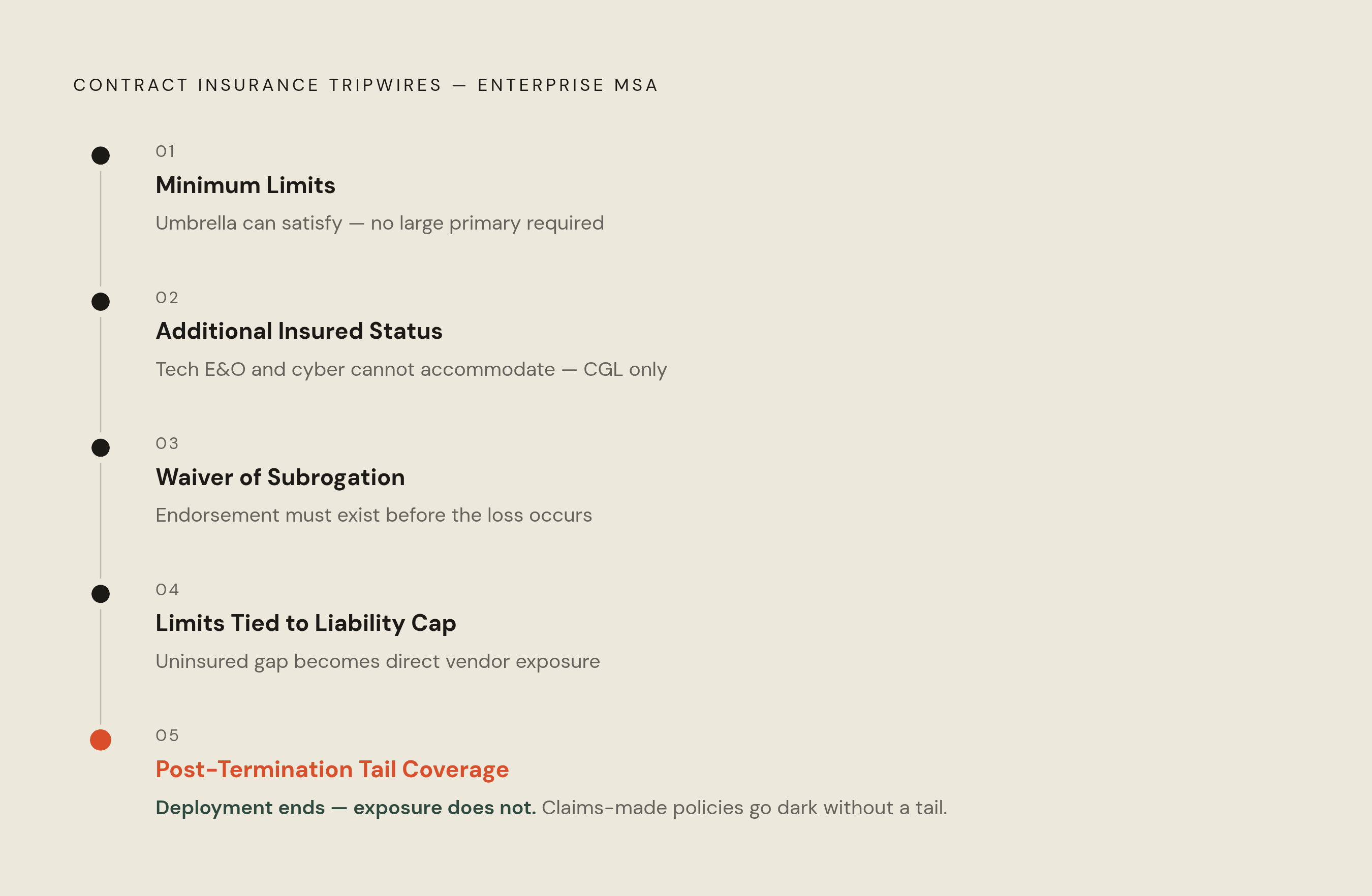
The first tripwire is a minimum limit that must be met before signature. Founders may treat a large per-claim or aggregate requirement as either an unavoidable primary-policy purchase or a problem to solve after closing. Neither assumption is sound. Some requirements can be met with a correctly structured follow-form umbrella over a lower primary limit, at a fraction of the cost of a large primary policy. Enterprise limits are also often negotiable for early-stage companies, including reduced limits with a commitment to increase them as revenue grows. Signing first instead risks misrepresenting coverage, with an uninsured shortfall exposed by a claim.
The second tripwire is additional insured status. MSAs routinely require the customer to be added to the vendor’s general liability policy, typically through an endorsement. Tech E&O and cyber often cannot accommodate that status in the same way. A promise to add the customer across all lines may therefore exceed what the policies support. When a robot-related loss crosses coverage lines, the responding policy and the customer’s status under it become central to whether the customer can recover.
The third tripwire is a waiver of subrogation, which requires the vendor’s insurer to waive its right to sue the customer after paying a claim on the vendor’s behalf. Only some carriers will agree to the endorsement, which must exist before the loss. A founder who accepts the clause without securing the endorsement has promised a restriction on the insurer’s rights that the policy does not provide.
The fourth tripwire links insurance limits to the contractual limitation of liability. Some MSAs require coverage at least equal to that cap, so negotiating the cap separately from the insurance exhibit can create an obligation to buy expensive or unavailable coverage. The apparent protection can be misleading. Where the cap exceeds the insurance limits, the uninsured gap becomes the vendor’s direct financial exposure. Indemnification structures and the liability cap need to be reviewed together with the insurance obligations.
The fifth tripwire requires coverage after the contract ends. Most Tech E&O and cyber policies are claims-made, so a claim must be reported within the policy period that applies, even if the work took place earlier. The deployment can end before the exposure does. If the company does not renew coverage or buy an extended reporting period, or tail coverage, a claim from that work that is reported later may go uninsured. Accepting a post-termination obligation without planning for that reporting window leaves both the claim and the contractual commitment unresolved.
How government contracts add a separate layer of mandatory coverage requirements above commercial MSA thresholds
Government work adds mandates that commercial negotiation cannot necessarily change. Government-backed contracts increasingly require more minimum liability coverage than standard commercial policies are set up to provide, along with specific requirements for the forms. The resulting gap can prevent execution of a public-sector contract even after a company has successfully met an enterprise customer’s insurance exhibit.
WTW notes that Texas and Arizona have clarified that companies can be held accountable for traffic violations by autonomous systems, while California requires manufacturers to demonstrate insurance, a surety bond, or self-insurance before public-road testing or operation. Space ventures face a different mandatory structure. Under 14 CFR 440.9, a licensee must buy third-party bodily injury and property damage liability insurance and separate coverage for damage to U.S. government property. The FAA sets the amounts through its maximum probable loss determination, illustrating why government requirements cannot be treated as merely larger commercial limits.
Why the underwriting submission determines whether a hardware company's policy actually satisfies the MSA
Underwriters price uncertainty, and the submission determines how much uncertainty they must absorb. Missing or inconsistent operational details lead to conservative assumptions that can produce higher premiums, lower limits, exclusions, or narrower endorsements. A generic application leaves critical questions unanswered. For robotics and AI companies, those questions include who owns and controls training data, how often models are reviewed or audited, and what happens when systems disagree with human decisions. Inadequate answers can lead to absolute AI exclusions or prohibitive premiums.
IMA Financial Group explains that strong AI governance and a safety culture can help companies get better terms or premiums, while poor controls can lead to exclusions or higher rates. That connects underwriting directly to contract compliance. A submission that describes autonomous operation, safety architecture, data logging, and where and how the hardware will be used gives the underwriter what they need to assess the risk. A generic submission may instead produce exclusions or limited endorsements incompatible with the MSA. Placing coverage that supports what the certificate must represent is the turning point.
What to do before countersigning an MSA with an insurance exhibit
The practical response is to review the insurance exhibit before the legal team works through the rest of the contract. Treat it as a binding commitment. Identify every coverage type, minimum limit, additional insured requirement, waiver of subrogation, and post-termination obligation before negotiating other terms. Read the liability cap and indemnification structure with those requirements so that the contractual exposure and available insurance are considered together.
Then compare each requirement with the actual policy forms and endorsements. Test coverage against the loss events the hardware could cause, rather than asking only whether the policy covers “AI.” Check for ISO exclusion endorsements and other wording that takes the company’s autonomous operations out of coverage. Identify which required lines are claims-made and which are occurrence-based. Where coverage must continue after termination, establish whether the carrier can support the obligation and what renewal or tail coverage will cost before accepting it.
Resolve limit shortfalls before signing or issuing the certificate. For an early-stage company, that may mean negotiating lower limits that rise as revenue grows or setting up a follow-form umbrella with the right structure. The remaining task requires a broker who understands autonomy. A specialist should describe the field operation accurately, know which carriers explicitly cover it, and read the wording before binding. Broker commissions are already included in the carrier’s premium, so this preparation costs nothing beyond that premium. The same preparation that produces coverage responsive to autonomous hardware losses also supports a certificate the enterprise MSA will accept.